
Exclusively featuring Winners Expeditions, Suvat Expeditions & Relax Africa Tours & Safari
Of all the paths that wind their way up the slopes of Mount Kilimanjaro — Africa’s highest peak and the world’s tallest free-standing mountain — none has captured the hearts and imagination of climbers quite like the Machame Route. Known throughout the mountaineering world as the “Whiskey Route” for its reputation as the more adventurous, more challenging, and more rewarding alternative to the gentler Marangu trail, the Machame Route has earned its place as Kilimanjaro’s most popular and most beloved climbing path through a combination of breathtaking scenery, outstanding acclimatization design, and the kind of raw, physical adventure that leaves climbers forever changed by the experience.
To climb Kilimanjaro via the Machame Route is to experience the mountain in its fullest, most dramatic expression. The trail traverses multiple ecological zones — from the dense, steaming rainforest of the lower slopes to the alien, wind-sculpted moorland, across the volcanic grandeur of the Southern Circuit, and finally up the steep, unforgiving scree of the summit cone to Uhuru Peak at 5,895 meters above sea level — creating a wilderness journey of extraordinary ecological and visual range. Every day on the Machame delivers a landscape so different from the one before that the mountain feels genuinely inexhaustible in its capacity to astonish.
Three operators have established outstanding reputations for guiding climbers to Kilimanjaro’s summit via the Machame Route with the combination of expert guidance, rigorous safety protocols, and deeply personal support that this magnificent mountain demands: Winners Expeditions, Suvat Expeditions, and Relax Africa Tours & Safari. Each brings to the Machame the local knowledge, certified mountain expertise, and genuine passion for Kilimanjaro that separates exceptional operators from ordinary ones — and makes the difference between a summit attempt and a summit achievement.
Key Takeaways
- The Machame Route is Kilimanjaro’s most popular and most scenic climbing path, renowned for its dramatic landscapes, outstanding acclimatization profile, and the raw, adventurous character that earns it the nickname the “Whiskey Route” among seasoned mountaineers.
- Winners Expeditions, Suvat Expeditions, and Relax Africa Tours & Safari are Tanzania’s most trusted Kilimanjaro Machame operators, delivering certified guides, comprehensive mountain equipment, expert altitude management, and unwavering climber support across every day of the ascent.
- The standard Machame Route takes 6 to 7 days, with the 7-day itinerary strongly recommended for its superior acclimatization schedule — the additional day on the mountain measurably increases summit success rates and meaningfully reduces the risk of altitude-related illness.
- The Machame Route traverses five distinct climate and vegetation zones — rainforest, heather and moorland, alpine desert, glacial zone, and summit — offering a wilderness experience of extraordinary ecological diversity unmatched by any other approach to Uhuru Peak.
- The route’s distinctive “high and low” acclimatization strategy — including the critical Lava Tower acclimatization walk on Day 4 — is the key to its impressive summit success rates and the reason experienced mountaineers consistently choose it over shorter, more compressed alternatives.
- The best time to attempt the Machame Route is during Tanzania’s dry seasons: January to mid-March and June to October — periods of clear skies, stable weather, and the most favorable trail and summit conditions available on the mountain.
- All three featured operators offer fully inclusive Machame packages covering national park and conservation fees, all mountain meals and accommodation, certified lead and assistant guides, a full porter team, emergency supplemental oxygen, comprehensive first aid, and pre-climb preparation briefings in Arusha.
Why the Machame Route Stands Apart
Every serious Kilimanjaro climber eventually confronts the same essential question: which route offers the best path to Uhuru Peak? The answer depends partly on individual preferences and partly on an honest assessment of what the mountain requires to be climbed safely and successfully. For the vast majority of climbers — those seeking a genuine adventure, outstanding scenery, strong acclimatization, and the sense of having truly earned their summit — the Machame Route is the answer that experienced guides, mountaineering professionals, and returning climbers consistently provide.
The route’s acclimatization architecture is its most practically important attribute. Altitude sickness is the primary reason climbers fail to reach Uhuru Peak — not insufficient fitness, not technical difficulty, but the body’s failure to adapt quickly enough to the progressive reduction in available oxygen as altitude increases. The Machame Route’s design directly addresses this challenge through deliberate pacing, built-in acclimatization days, and the critical Lava Tower detour on Day 4, in which climbers ascend to approximately 4,600 meters before descending to sleep at a lower altitude — a strategy that stimulates physiological adaptation without the risk of sleeping at a dangerously high altitude before the body is ready.
The route’s visual and ecological drama is the quality that most first-time climbers are unprepared for. Having expected a demanding but straightforward mountain hike, they find instead a journey through landscapes of such extraordinary variety and beauty — the green cathedral of the rainforest, the wind-bent heather of the moorland plateau, the volcanic surrealism of the Shira Plateau and Lava Tower, the otherworldly silence of the alpine desert, and the glacial magnificence of the summit zone — that the mountain feels less like a single climb and more like a series of complete, distinct wilderness experiences seamlessly connected by a single trail.
The Machame Route also benefits from the Southern Circuit traverse on Days 4 and 5 — a high-altitude walk across the southern face of the mountain that provides extended views of the Southern Ice Fields, the summit glaciers, and the vast Tanzanian plains thousands of meters below, and that delivers the Barranco Wall scramble: one of the most exhilarating and genuinely memorable physical challenges available on any mountain in Africa.
Winners Expeditions, Suvat Expeditions, and Relax Africa Tours & Safari guide the Machame Route with the deep familiarity of operators who have traversed its trails across hundreds of successful climbs — knowing every camp, every weather pattern, every acclimatization nuance, and every motivational moment a climber needs to hear on the way to the summit.
Day-by-Day: The 7-Day Machame Route Itinerary
Day 1 — Arusha to Machame Gate & Machame Camp (3,000m)
Your Kilimanjaro adventure begins in Arusha, where your lead guide from Winners Expeditions, Suvat Expeditions, or Relax Africa Tours & Safari conducts a comprehensive pre-climb briefing — reviewing equipment, establishing the acclimatization strategy, explaining daily health assessment protocols, and answering every question the team brings to the table. The drive to Machame Gate on Kilimanjaro’s southern slope takes approximately one hour before the mountain’s famous rainforest receives you.
The first day’s hiking is a long, green immersion — five to six hours through dense montane rainforest alive with the calls of Hartlaub’s turaco, the silver-cheeked hornbill, and dozens of other forest bird species. The trail is muddy in places, shaded throughout, and carries the particular quality of enclosed, living wilderness that the mountain’s lower slopes are famous for. Arriving at Machame Camp at around 3,000 meters, your porter team has established camp with the efficiency and quiet pride that characterizes the best mountain crews on the mountain. The forest canopy thins just enough above camp to reveal the first tantalizing glimpse of the high mountain above — and the scale of what lies ahead becomes suddenly, thrillingly real.
Day 2 — Machame Camp to Shira Camp (3,840m)
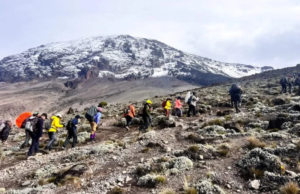
The trail climbs steadily out of the upper rainforest into the heather and moorland zone, where the vegetation transforms dramatically and the mountain opens up around you. Giant heather trees give way to moorland shrubs, and the first broad views of the summit plateau emerge above the treeline with a visual impact that stops most climbers in their tracks. This is the day Kilimanjaro reveals itself as a genuinely grand mountain — the summit ice fields visible above, the Tanzanian plains spreading to every horizon below, and the trail cutting across a landscape that belongs to no other mountain on Earth.
Arriving at Shira Camp on the edge of the extraordinary Shira Plateau, the day’s six-hour hike has delivered you to a high-altitude world of sweeping moorland, volcanic rock formations, and a sky so vast and clear at this elevation that the stars at night seem close enough to touch. Your guides conduct the first formal health assessment of the climb — pulse oximeter readings, symptom review, and a brief discussion of how each climber is acclimatizing — establishing the daily health monitoring rhythm that continues every morning and evening until the summit.
Day 3 — Shira Camp to Lava Tower Acclimatization Walk & Barranco Camp (3,960m)
The third day introduces the Machame Route’s most strategically important element: the acclimatization walk to Lava Tower. The trail climbs from Shira Camp across the high plateau to the imposing volcanic plug of the Lava Tower at approximately 4,600 meters — well above the altitude at which the effects of reduced oxygen become clearly and uncomfortably noticeable. After spending time at the tower and allowing the body to register the altitude stress, the trail descends to Barranco Camp at 3,960 meters for the night.
The physiological principle behind this approach is elegantly effective: ascend to higher altitude during the day to stimulate red blood cell production and other acclimatization responses, then descend to sleep at a lower altitude where recovery is more efficient. By waking at Barranco Camp the following morning, climbers have taken a significant, measurable step in their bodies’ adaptation to altitude — a step that makes the summit push several days later substantially more achievable. The Lava Tower day also delivers some of the Machame Route’s most dramatic mountain scenery, with the Southern Ice Fields and the summit glaciers filling the sky above and the full sweep of the southern face visible in extraordinary detail.
Day 4 — Barranco Camp to Karanga Camp via Barranco Wall (4,035m)
The Barranco Wall is the moment that every Machame climber anticipates with a mixture of apprehension and excitement — and experiences with pure, exhilarated satisfaction. This near-vertical cliff face of approximately 300 meters rises directly above Barranco Camp and requires genuine hands-on scrambling to ascend, with sections where both hands and feet are engaged simultaneously and the exposure below adds a welcome edge of adventure to the morning. It sounds formidable in description. It is entirely achievable with the expert guidance and patient, motivating support provided by all three operators’ mountain teams. And the views from the top of the wall — across the Southern Circuit to the summit above and the savanna below — are among the finest on the entire route.
The afternoon continues along the Southern Circuit traverse to Karanga Camp, a high-altitude setting of stark, beautiful volcanic landscape where the increasing bareness of the terrain signals that you are firmly in the mountain’s upper realm and that the summit is now genuinely, measurably close.
Day 5 — Karanga Camp to Barafu High Camp (4,673m)
The trail to Barafu High Camp — the staging point for the summit push — is a relatively short but psychologically loaded day. The camp sits on a ridge at 4,673 meters in the alpine desert zone, where the mountain’s volcanic rock is unadorned by any vegetation and the wind cuts across the exposed slopes with an authority that requires proper layering and a respectful acknowledgment that altitude is now a very present reality.
Your guides from Winners Expeditions, Suvat Expeditions, or Relax Africa Tours & Safari conduct the summit briefing at Barafu with thoroughness and calm confidence — covering the midnight departure time, the expected six to eight hour ascent to Uhuru Peak, the turnaround protocols that protect every climber’s safety, the equipment requirements, and the mental strategies that help climbers through the most challenging hours of the night. An early dinner at approximately 5:00 PM. An attempt at sleep in the thin, cold, summit-eve air. And then the alarm sounds in the absolute darkness before midnight — and everything changes.
Day 6 — Summit Night: Barafu to Uhuru Peak (5,895m) & Descent to Mweka Camp (3,100m)
Midnight. Headtorches illuminating the steep, dark trail above. The temperature is well below zero. The pace is deliberately slow — one measured, deliberate step at a time, breathing steadily, moving upward with the patience and purpose that the mountain demands. The summit push on the Machame Route follows the volcanic scree trail from Barafu through the switchbacks above, past the increasingly dramatic glacial formations, to Stellar Point at 5,739 meters on the crater rim — where the view across the summit crater and the full sweep of the night-dark African continent below produces an emotion that no one who has experienced it has ever adequately described.
From Stellar Point, the trail continues along the crater rim to Uhuru Peak — the highest point on the African continent at 5,895 meters above sea level. The famous green and yellow summit sign. The glacier walls rising on either side. The extraordinary, humbling realization that you are standing on the roof of Africa. Every climber’s experience at Uhuru Peak is personal and unrepeatable — tears are common, laughter is common, silence is common — but the quality of profound, earned achievement is universal. Your guide stands beside you, proud, and the photograph taken at this moment is one you will return to for the rest of your life.
The long descent to Mweka Camp tests the knees and the final reserves of energy, but the euphoria of the summit sustains every step down.
Day 7 — Mweka Camp to Mweka Gate & Return to Arusha
The final morning descent through the rainforest to Mweka Gate is a gentle, satisfying denouement — the mountain releasing you back into the warmer, greener, oxygen-rich lower world with a generosity that mirrors the generosity it showed in granting the summit the day before. Summit certificates are collected at the gate. Tips are distributed to the porter team — men who carry extraordinary loads over extraordinary terrain and deserve extraordinary recognition. Your operator’s vehicle is waiting, and Arusha — with its comfortable lodges, its celebratory dinners, and its return to the ordinary world — receives you as a different person from the one who left it seven days ago.
The Operators Who Will Take You to the Top
Winners Expeditions
Winners Expeditions brings to every Machame Route package the rare combination of deep mountain expertise and genuine personal investment in each climber’s success. Their lead guides are KINAPA-certified professionals with extensive Kilimanjaro experience, advanced wilderness first aid qualifications, and the motivational intelligence that distinguishes truly exceptional mountain guides from merely competent ones. Winners Expeditions designs their Machame packages with meticulous attention to every safety detail — twice-daily health assessments, emergency oxygen on every climb, clear and practiced turnaround protocols, and a porter welfare standard that reflects their commitment to ethical, responsible mountain tourism. Their fully inclusive packages are transparent in pricing and comprehensive in coverage, ensuring that climbers arrive at Machame Gate with complete confidence in the team guiding them upward.
Suvat Expeditions
Suvat Expeditions approach every Kilimanjaro Machame climb with the same deeply personalized philosophy that defines their entire operation. Recognizing that every climber arrives at the mountain with a different fitness baseline, a different altitude experience history, and a different personal relationship with physical challenge, Suvat Expeditions tailors their guiding approach and pacing strategy to each individual in the team — paying close attention to acclimatization responses, adjusting the day’s rhythm to support each climber’s optimal adaptation, and providing the specific motivational support that each person needs at each stage of the ascent. Their mountain guides are among the most accomplished on Kilimanjaro — skilled naturalists and experienced high-altitude professionals who bring both technical expertise and genuine human warmth to every day on the mountain.
Relax Africa Tours & Safari
Relax Africa Tours & Safari delivers the Machame Route experience with the seamless, stress-free excellence and exceptional client care that defines their approach to every journey they guide. From the moment you arrive in Arusha for your pre-climb briefing to the moment their vehicle collects you from Mweka Gate at the end of the descent, every logistical element of a Relax Africa Machame package is managed with complete precision and genuine attentiveness to each climber’s needs and wellbeing. Their mountain teams are outstanding — experienced, certified, deeply knowledgeable about Kilimanjaro’s conditions and challenges, and genuinely motivated by the success of every climber they guide. For travelers who want to focus entirely on the extraordinary experience of climbing Africa’s greatest mountain without a single moment of logistical concern, Relax Africa Tours & Safari provides exactly that environment.
Frequently Asked Questions
Q: What is the difference between the 6-day and 7-day Machame Route itineraries?
The 7-day Machame itinerary includes an additional acclimatization day — typically an extra night at Karanga Camp between the Barranco Wall day and the Barafu High Camp arrival — that provides a significantly improved altitude adaptation opportunity before the summit push. All three featured operators strongly recommend the 7-day version: the additional night at altitude costs one extra day but delivers a measurable improvement in summit success rates and a meaningful reduction in altitude-related illness risk. The difference between reaching Uhuru Peak and turning back below the crater rim frequently comes down to whether the body has had adequate time to acclimatize — and the 7-day itinerary provides that time.
Q: How fit do I need to be to climb Kilimanjaro via the Machame Route?
The Machame Route requires solid cardiovascular fitness and the capacity to hike for six to eight hours per day across varied, sometimes challenging terrain for six to seven consecutive days with a day pack. No technical mountaineering skills or prior high-altitude experience are necessary — Kilimanjaro is a non-technical mountain. The most important physical qualities are cardiovascular endurance, leg strength, and the mental resilience to maintain consistent effort over many consecutive days. All three operators provide detailed pre-climb fitness preparation programs upon booking, typically recommending a training program beginning three to four months before the climb.
Q: What altitude sickness risks should I be aware of on the Machame Route?
Acute Mountain Sickness (AMS) is the most common health challenge on Kilimanjaro, presenting as headache, nausea, fatigue, and dizziness at altitude. More serious forms — High Altitude Pulmonary Edema (HAPE) and High Altitude Cerebral Edema (HACE) — are rare but require immediate descent if they develop. All three featured operators conduct twice-daily pulse oximeter health assessments throughout the climb, use the Lake Louise Score system for symptom monitoring, carry emergency supplemental oxygen on every expedition, and have clear, practiced protocols for descent if a climber’s condition warrants it. Diamox (acetazolamide) is widely used as a prophylactic medication — consult your physician well before your climb regarding its suitability for you.
Q: When is the best time of year to attempt the Machame Route?
The two dry seasons offer the most favorable climbing conditions. January to mid-March provides clear skies, cold but settled summit conditions, and the visual drama of the snow-covered upper mountain. June to October — the long dry season — is the most popular period, offering reliable weather windows, excellent trail conditions, and peak summit success rates. Both the long rains (April–May) and the short rains (November) are possible but come with muddier trails, reduced visibility, and less predictable summit weather. All three operators advise on the optimal timing based on your availability and specific summit priorities.
Q: What equipment is provided by the operators, and what must I bring myself?
Winners Expeditions, Suvat Expeditions, and Relax Africa Tours & Safari provide all group camping equipment — tents, dining tents, cooking equipment, and toilet facilities — as well as emergency oxygen, comprehensive first aid kits, and all communal meal preparation. Personal equipment — hiking boots, layering system, summit jacket, sleeping bag rated to minus 15 degrees Celsius or below, trekking poles, headtorch, and personal medications — must be provided by the climber. All three operators offer equipment rental for climbers who prefer not to purchase specialist gear, and comprehensive personal gear checklists are provided upon booking confirmation.
Q: How are porters treated on expeditions with these operators?
All three featured operators — Winners Expeditions, Suvat Expeditions, and Relax Africa Tours & Safari — maintain exemplary porter welfare standards that comply with and in many cases exceed the ethical guidelines established by the Kilimanjaro Porters Assistance Project. Porter loads are regulated to prevent overloading, appropriate clothing and equipment are provided, porters receive fair wages above the gazetted minimum, and their health and wellbeing are monitored throughout the climb alongside that of the climbing clients. Choosing an operator with strong porter welfare standards is one of the most important ethical decisions a Kilimanjaro climber makes, and all three featured operators make that choice straightforward and confident.
Conclusion
The Machame Route is Mount Kilimanjaro at its most fully realized — the most scenic, the most adventurous, the most ecologically diverse, and the most deeply satisfying path to the summit of Africa’s greatest mountain. It demands genuine effort over seven consecutive days of mountain hiking through landscapes that shift from tropical forest to volcanic moonscape, from high moorland to glacial summit with a variety and drama that makes every morning’s departure from camp feel like the beginning of an entirely new experience. It rewards that effort with summit success rates that reflect the superiority of its acclimatization design — and with the particular, permanent satisfaction of having earned Uhuru Peak on a trail that does not give the summit away cheaply.
The view from Uhuru Peak at dawn, with the glaciers catching the first light and the entire African continent spread below you in every direction, is not something that photographs adequately capture or words convincingly describe. It is something you carry inside you from the moment you turn from the summit sign and begin the long, grateful descent — a new and permanent part of who you are.
Winners Expeditions, Suvat Expeditions, and Relax Africa Tours & Safari exist to make that moment possible for every climber they guide. They bring to the Machame Route the expertise, the safety rigor, the logistical mastery, and the genuine, personal care for each climber’s success that Kilimanjaro demands and that every summit deserves. In their hands, the mountain is not simply a physical challenge — it is a guided, supported, deeply memorable journey to the roof of Africa and back.
Prepare well. Trust your team. Step by step, Uhuru Peak becomes yours.